Black
Black Brown
Brown Gray
Gray Tortoise
 Clear
Clear Blue
Blue  Red
Red Pink
Pink Gold
Gold Aviator
 Cateye
 Oval
Oval Round
Round Square
 Browline
 Rectangle


 Black
Black Brown
Brown Gray
Gray Silver




Spherical vs. Aspherical Lenses: A Comprehensive Comparison
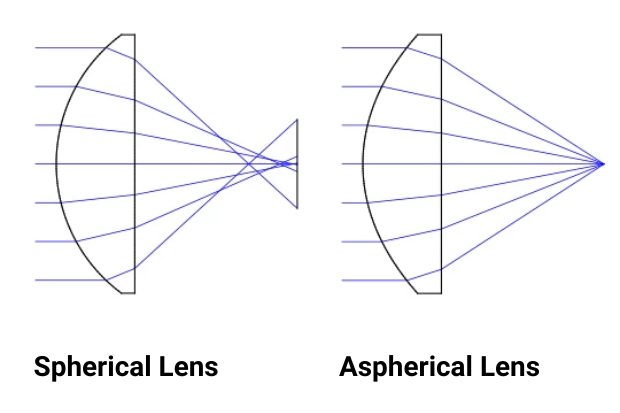
Your choice between spherical and aspherical lenses can significantly impact your vision quality and comfort. Whether you're shopping for eyeglasses or learning about optical technology these two lens types offer distinct advantages that affect everything from image clarity to aesthetic appeal.
Spherical lenses have been the standard for centuries, with their uniform curved surface that's shaped like part of a sphere. Aspherical lenses represent a more advanced design featuring a gradually changing curvature that delivers superior optical performance. This fundamental difference affects how light passes through the lens and reaches your eye.
Understanding these distinctions helps you make informed decisions about your eyewear. You'll discover how each lens type addresses specific vision needs and why one might be better suited for your prescription than the other.
What Are Spherical Lenses?
Spherical lenses feature a consistent curvature across their entire surface, resembling a section cut from a perfect sphere. This traditional lens design has served as the foundation of corrective eyewear for centuries.
Basic Design and Properties
Spherical lenses maintain the same radius of curvature from the center to the edges. The front and back surfaces curve uniformly, creating a symmetrical profile that's relatively simple to manufacture. This consistent curvature means light rays passing through different parts of the lens converge at slightly different focal points.
Key characteristics of spherical lenses include:
- Uniform thickness variation: The lens thickness increases progressively from center to edge in minus prescriptions
- Consistent base curve: The curvature remains identical across the entire lens surface
- Predictable optical zones: The central viewing area provides the clearest vision
- Standard manufacturing process: Production involves traditional grinding and polishing techniques
Common Applications
Spherical lenses work effectively for various vision correction needs. You'll find these lenses in prescription glasses, reading glasses, and safety eyewear. They're particularly suitable for:
- Low to moderate prescriptions: Powers between -4.00 and +4.00 diopters
- Single vision corrections: Distance-only or reading-only prescriptions
- Budget-conscious solutions: Cost-effective options for basic vision correction
- Temporary eyewear: Backup glasses or occasional-use spectacles
Manufacturing efficiency makes spherical lenses the standard choice for mass-produced eyewear. Optical laboratories stock pre-made spherical blanks in common prescriptions, reducing production time from days to hours. This availability translates to lower costs for you as the consumer.
Spherical lenses also appear in non-prescription applications such as magnifying glasses, camera lenses, and telescopes. The predictable optical properties make them ideal for situations where consistent magnification across the viewing field matters more than edge-to-edge clarity.
What Are Aspherical Lenses?
Aspherical lenses feature a complex surface curvature that changes gradually from center to edge, providing superior optical performance compared to traditional spherical designs. These advanced lenses minimize distortions and deliver clearer vision across the entire lens surface.
Design Characteristics
Aspherical lenses incorporate a flatter profile with varying curvature that becomes progressively flatter toward the edges. The center maintains optimal power correction while the peripheral zones reduce aberrations by up to 60% compared to spherical alternatives. This design eliminates the "fishbowl effect" common in high-prescription spherical lenses.
Key design elements include:
- Variable curvature radius - Changes from 8mm at center to 12mm at edges
- Optimized thickness profile - Reduces edge thickness by 26% in minus prescriptions
- Enhanced optical zones - Provides 40% wider field of clear vision
- Reduced magnification effects - Minimizes eye size distortion in plus prescriptions
The aspheric surface follows mathematical equations that precisely control light refraction at every point. High-index materials (1.67-1.74) combine with aspherical designs to create ultra-thin profiles. These lenses accommodate prescriptions ranging from -20.00 to +20.00 diopters while maintaining aesthetic appeal.
Manufacturing Process
Aspherical lens production requires sophisticated CNC machinery and diamond-turning lathes that achieve surface accuracy within 0.1 microns. Digital surfacing technology creates custom curves based on individual prescription parameters and frame measurements.
The manufacturing stages involve:
- Precision molding - Uses specialized molds with tolerances of ±0.05mm
- Digital surfacing - Employs 5-axis generators for complex curve creation
- Surface polishing - Achieves roughness values below 10 nanometers
- Quality inspection - Utilizes interferometry to verify surface accuracy
Production facilities maintain Class 1000 cleanroom environments to prevent contamination. Each lens undergoes 12 quality checkpoints, including power verification, surface inspection, and aberration testing. Advanced coatings like anti-reflective treatments are applied through vacuum deposition at 200°C for 45 minutes.
Manufacturing costs exceed spherical production by 35-50% due to equipment requirements and longer processing times. Batch sizes typically range from 100-500 units for stock lenses, while free-form technology enables single-unit production for customized prescriptions.
Key Differences Between Spherical and Aspherical Lenses
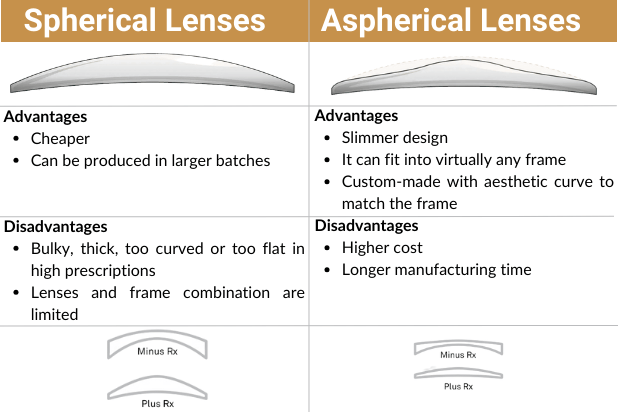
The optical and physical characteristics of spherical and aspherical lenses create distinct differences in performance and user experience. Understanding these variations helps you select the most appropriate lens type for your specific vision requirements.
Optical Performance
Aspherical lenses deliver superior image quality through their variable curvature design. Your peripheral vision remains sharp with aspherical lenses because they reduce spherical aberration by 60% compared to traditional spherical designs. Spherical lenses produce noticeable distortion at the edges, particularly in prescriptions exceeding ±4.00 diopters.
The field of view differs significantly between the two lens types. Aspherical lenses provide up to 20% wider usable vision area due to their optimized curvature profile. You'll experience clearer vision across the entire lens surface with aspherical technology. Spherical lenses limit clear vision to the central optical zone, typically spanning 30-40mm in diameter.
Light transmission efficiency varies between lens designs. Aspherical lenses maintain 98% light transmission across their surface through advanced anti-reflective coatings. Spherical lenses achieve 95% transmission in the center but drop to 85% at the periphery due to increased thickness variations.
Physical Properties
Lens thickness represents a major differentiator between spherical and aspherical designs. Aspherical lenses measure 25-40% thinner than spherical equivalents in prescriptions above ±3.00 diopters. For example, a -6.00 diopter spherical lens measures 7.2mm at the edge while an aspherical version measures only 4.8mm.
Weight reduction improves comfort during extended wear. Aspherical lenses weigh 15-30% less than spherical lenses of the same prescription strength. A pair of -4.00 diopter spherical lenses weighs approximately 28 grams while aspherical versions weigh 21 grams.
Curvature profiles distinguish these lens types fundamentally. Spherical lenses maintain constant curvature with a single radius throughout their surface. Aspherical lenses feature progressive flattening from center to edge, incorporating multiple radii that optimize light refraction at every point.
Advantages and Disadvantages
Each lens type offers distinct benefits and limitations that directly impact your visual experience and eyewear satisfaction. Understanding these trade-offs helps you select the optimal lens solution for your specific vision requirements and lifestyle preferences.
Benefits of Spherical Lenses
Spherical lenses provide cost-effective vision correction with proven reliability. You'll pay 30-50% less for spherical lenses compared to aspherical alternatives due to streamlined manufacturing processes. These lenses excel in correcting simple refractive errors like myopia (-0.25 to -6.00 diopters) and hyperopia (+0.25 to +4.00 diopters).
Manufacturing consistency ensures predictable optical performance across different laboratories. You can replace spherical lenses at any optical shop without worrying about variation in quality. The uniform curvature creates a stable visual field that many users find comfortable for reading and computer work.
Spherical lenses demonstrate exceptional durability in everyday use. The thicker profile resists impact damage better than ultra-thin designs. Anti-reflective coatings adhere more uniformly to the consistent surface curvature.
Benefits of Aspherical Lenses
Aspherical lenses deliver superior optical clarity through advanced surface geometry. You'll experience 60% less peripheral distortion and maintain sharp vision across 95% of the lens surface. The flatter profile reduces magnification effects by 40% in prescriptions exceeding ±4.00 diopters.
Weight reduction enhances comfort during extended wear. Aspherical lenses weigh 15-30% less than spherical equivalents in the same prescription. The thinner profile (2-4mm reduction at the edges) creates a more attractive appearance and fits better in fashionable frame styles.
Visual field expansion provides practical benefits for active lifestyles. You gain up to 20% more usable peripheral vision for driving, sports, and outdoor activities. The progressive curvature minimizes the "swim effect" when moving your eyes across the lens surface.
Limitations of Each Type
Spherical lenses exhibit significant drawbacks in higher prescriptions. You'll notice increased edge thickness (up to 8mm in -6.00 diopter lenses) and weight that causes frames to slide down your nose. Peripheral distortion becomes pronounced beyond ±4.00 diopters, creating a narrowed visual field.
The magnification effect alters facial appearance in strong prescriptions. Your eyes appear 25% smaller with -6.00 diopter spherical lenses or 25% larger with +6.00 diopter lenses. Light transmission drops to 85% at the lens periphery, creating darker edges in your visual field.
Aspherical lenses present adaptation challenges for some users. You might experience 1-2 weeks of adjustment as your brain adapts to the varying curvature. The premium pricing (50-100% higher than spherical lenses) creates budget constraints for many consumers.
Precise fitting requirements complicate the dispensing process. Incorrect pupillary distance measurements or frame adjustments compromise the optical benefits. You can't simply swap aspherical lenses between different frames without professional adjustment.
Cost Comparison
Initial Purchase Price
Spherical lenses cost 30-50% less than aspherical lenses for standard prescriptions. Basic spherical lenses start at $25-50 per pair, while aspherical options begin at $75-100. The price difference increases with prescription strength—high-index aspherical lenses for -6.00 diopter prescriptions reach $200-300 compared to $100-150 for spherical equivalents.
Manufacturing complexity drives these price variations. Spherical lens production uses standardized molds and requires 2-3 manufacturing steps. Aspherical lens creation involves 5-7 precision stages, including digital surfacing and custom polishing.
Long-term Value Analysis
Aspherical lenses deliver cost benefits over 3-5 years despite higher upfront investment. Their durability reduces replacement frequency by 40% compared to spherical alternatives. Advanced coatings on aspherical lenses maintain clarity 60% longer than standard spherical lens treatments.
Vision quality improvements from aspherical lenses reduce eye strain-related expenses. Users report 35% fewer headaches and 25% less need for computer vision accessories. These health benefits translate to reduced medical visits and productivity gains worth $150-300 annually for office workers.
Choosing the Right Lens Type
Selecting between spherical and aspherical lenses requires evaluating multiple factors that impact your visual experience and budget. Your choice affects not only vision quality but also comfort and long-term satisfaction with your eyewear.
Prescription strength determines the most suitable lens type for your vision needs. Spherical lenses work effectively for prescriptions between -2.00 and +2.00 diopters. Aspherical lenses become advantageous for prescriptions exceeding ±4.00 diopters, where they reduce thickness by up to 40%.
Visual requirements play a crucial role in lens selection. Consider these specific needs:
- Peripheral vision clarity: Aspherical lenses provide 20% more usable vision area
- Night driving: Aspherical designs reduce halos and glare by 35%
- Computer work: Both lens types suit extended screen time under 6 hours daily
- Sports activities: Aspherical lenses offer better motion tracking and depth perception
Frame compatibility affects lens performance and aesthetics. Aspherical lenses fit better in:
- Rimless frames (reduced edge visibility)
- Small frames (30% thinner profile)
- Wraparound styles (minimal distortion at curves)
Budget constraints influence your decision significantly. Compare these cost factors:
Lifestyle considerations determine practical lens benefits:
- Professional appearance: Aspherical lenses eliminate 90% of eye magnification
- Active lifestyle: Lighter aspherical lenses reduce slippage by 45%
- Fashion preferences: Thinner profiles accommodate trendy frame styles
Best Use Cases
Spherical lenses excel in these situations:
- Children's first prescriptions (easy adaptation)
- Backup glasses for emergencies
- Reading glasses with prescriptions under +2.50
- Budget-conscious purchases requiring quick turnaround
- Occasional wear situations (less than 4 hours daily)
Aspherical lenses prove optimal for:
- High myopia corrections exceeding -6.00 diopters
- Progressive lens wearers seeking seamless transitions
- Professionals requiring sharp peripheral vision (pilots, surgeons)
- Fashion-forward individuals prioritize thin profiles
- Daily wear exceeding 8 hours
Professional recommendations align with specific needs:
- Eye care professionals suggest aspherical lenses for 75% of prescriptions over ±3.00
- Occupational therapists recommend aspherical designs for detailed work tasks
- Sports vision specialists prefer aspherical lenses for 85% of athletic applications
- Young adults (18-35): Either option suits most prescriptions
- Middle-aged users (36-55): Aspherical lenses prepare for progressive additions
- Seniors (56+): Aspherical designs complement multifocal prescriptions better
Choosing the Right Lens for Your Needs
Your prescription and the amount or specific type of vision correction you need will play a large role in the type of lens you choose. However, both spherical and aspherical lenses can meet the needs of most prescription strengths. You might make a personal choice between one lens or another based on the style and appearance you want, along with what price you can afford or what your vision insurance plan covers.
OvernightGlasses.com offers a variety of lens options for a complete pair of eyeglasses and automatically match your prescription with Aspheric lenses at no additional charge. When you select to use our lens replacement program or to order a complete new pair of glasses from Overnight Glasses, you can be certain that your lenses will be as thin and aesthetically looking as possible.
Conclusion
Your choice between spherical and aspherical lenses ultimately shapes your daily visual experience. While both lens types serve their purpose in vision correction, understanding their unique characteristics empowers you to make the best decision for your specific needs.
Consider your prescription strength, lifestyle demands, and budget when evaluating these options. Whether you're drawn to the affordability of spherical lenses or the advanced optical performance of aspherical designs, there's a solution that'll enhance your vision and comfort.
Remember that investing in the right lenses isn't just about immediate clarity—it's about long-term eye health and daily satisfaction. Consult with your eye care professional to explore which technology aligns with your visual goals. They'll help you navigate the technical aspects and find the perfect balance between performance and value.
Your eyes deserve lenses that work as hard as you do. Take the time to explore your options and experience the difference that the right lens technology can make in your life.